Monday, April 18, 2011

Interview with Kevin Hearne (Interviewed by Mihir Wanchoo)

Order “HoundedHERE
(Photo Credit: Kevin Hearne)

Amongst the various genres which I read, I’m always fascinated by Urban Fantasy. I think it’s due to the juxtaposition of the magical with the mundane world which gives most readers—including me-a reading high of sorts. In this sub genre, things are often competitive as there are only so many legends and mythologies which one can utilize and so it is always fun for me to discover new authors who manage to subvert old plots with new twists and/or take upon lesser-utilized mythos. One such person is debut author Kevin Hearne who snagged my interest when his book series, The Iron Druid Chronicles, was announced last year. I managed to get my hands on the first three books in the series—Hounded, Hexed and Hammered—which I’ll be reviewing in the forthcoming weeks. I really enjoyed the novels and immediately wanted to know more about the author behind the books. So I’m deeply grateful to Kevin Hearne who graciously agreed to answer the questions amidst his hectic work schedule and to Robert Thompson for his help with some of the questions. Now onto the interview with the man whose vivid imagination has flowered quite a tale set in the Arizona desert…

Q: Thank you very much for agreeing to participate in an interview. To begin with, could you introduce yourself for our readers and tell us what set you on the path of a writer?

Kevin: I love to read and write; I teach American Lit for my day job. What got me interested in writing was Ken Kesey’s novel, One Flew Over the Cuckoo’s Nest. It was such a brilliant example of what can be achieved through point of view and voice. It spoke to me like no other book had done before, and I wanted to tell stories with a voice like that. All of my favorite books are first-person narratives with extraordinary voice—To Kill a Mockingbird, The Adventures of Huckleberry Finn, and so on.

Q: You have set your series in Tempe, Arizona. I cannot say that I’m a seasoned Urban Fantasy reader, however I don’t think there is much Urban Fantasy set in Arizona. What prompted you to choose this particular setting besides it being your native state?

Kevin: Familiarity was certainly part of it, but since my main character is a Druid hiding out from the Fae, a desert seemed like a good place for him to hide. And I also thought readers might be ready for some stories outside of New York and L.A.

Q: Could you elaborate more on the journey you went through in finding a publisher, what you think of Del Rey, and what you think they saw in your book?

Kevin: I started writing in college and I’m “self-taught” in the sense that I never attended a writing conference or took classes. I must have begun three or four novels and never finished them. My first completed novel took me six years, and I kind of knew from the start that it wasn't very good, but I submitted it anyway and got rejected quickly. I shrugged it off as a training novel, because the hugely important lesson that I learned from it was that I could finish writing one. My next book was an epic fantasy; it was twice as long and only took me half the time. I actually got some nibbles on that one, but while it was out on submission I got the idea for Hounded.

I’d been reading a lot of urban fantasy and thought perhaps it would be fun to drop a Druid into the modern world. The odd thing was how fast I wrote it compared to the others; it took less than a year. I sent some queries out to agents, an intern found me in the slush pile, and I had representation in about six weeks. Once my agent submitted Hounded, he got very positive responses and we sold it at auction to Del Rey. Who, of course, are simply fabulous to work with; as far as what they saw in my work, my editor says what grabbed her was the voice, so that made me very happy.

Q: How do you plan on celebrating your first book which is published on the 3rd of May?

Kevin: I’m going into a bookstore and taking a picture of it on the shelf, because seeing something I wrote in a bookstore has been my dream for twenty years now. I’m going to buy it, sign it, and give it to the person working at the register. Then I’m going to go have a beer at an Irish pub. I’m having a launch party on May 9 at Changing Hands bookstore in Tempe, and the festivities after that will be a bit more extensive.

Q: Since Hounded is your first published novel, what did you think was the most challenging part about writing the book? What about the easiest or most rewarding?

Kevin: Anything involving police procedure is challenging for me, as are the fight scenes. I don’t watch crime drama and I don’t fight, so those bits take quite a bit of work on my part. The easiest bits (and the most fun for me) are slipping in allusions to literature.

Q: So when and how did the idea for The Iron Druid Chronicles first come about, how long have you been working on it, and how much has it evolved from its original conception (if any)?

Kevin: The idea was spawned in the spring of 2008. I was reading a lot of urban fantasy at the time and was trying to figure out a way to contribute to the genre that hadn't already been done. A male protagonist seemed like a good idea, since there weren't many males on the scene back then (and there still aren’t). And then, I confess, I wanted a hero who could talk to his dog, because I’m a dog person and I’ve always wished I could do that. Once that was decided, it kind of grew organically based on my own love for Celtic myth: My hero would be a real Druid who could tap the magic of the earth and talk to animals if he wished. So I did a wee bit of market analysis at the front end to find an unoccupied niche in urban fantasy, but this whole thing really snowballed once I put names to Atticus and Oberon.

Q: Speaking of the series, how many volumes are projected, how far along are you in the next book, and is there anything you can tell us about books 4 & 5?

Kevin: As of this moment, I’m not under contract for anything past Hammered. If the first three books do well, I’m shooting for either seven or nine volumes. Eight is simply impossible, so is ten, and eleven seems unforgivably long. I’m 40% through book four right now, hoping that people will dig the first three and tell all their friends. You can keep track of where I’m at on my blog; I keep progress meters on the sidebar (right hand side column). Book four will be called Tricked and book five is called Trapped.

Q: In the fantasy genre, cover art has always been a hot topic, especially how important it is in selling books. How do you feel about the covers for your books and what are your thoughts on the difference between Urban Fantasy covers from say “Paranormal romance”, et cetera?

Kevin: I love my covers, and Del Rey was an absolute dream to work with in that regard. My editor and I actually put together a piece on the creation of the cover for Hounded. Here’s the link for it if you’d like to check it out. I think UF covers tend to feature more weapons and slightly more clothing than paranormal romances do, and I definitely pushed to make sure Atticus was fully clothed on the cover.

Q: What are some activities or hobbies you enjoy?

Kevin: I collect comic books; I paint canvases and miniature models; I catch Shakespeare plays whenever I can; and I hug trees, both literally and figuratively.

Q: Your world is a melting pot of multiple mythologies; usually most books are centered on a singular mythology. What was the thinking process behind this move?

Kevin: It’s easy for people to point at someone else’s beliefs and say, “Hey, somebody just made that up a long time ago,” but not so easy for them to admit their own beliefs were made up too. The idea here is that yes, all the gods are made up, but that means that they’re all equally real, all equally valid. And I’ve been having tremendous fun playing with the idea that just as governments derive their powers from the governed, so do gods derive their powers from their worshippers. The true power is on the worshippers’ side. But if all these gods are real and still kicking today, why don’t we see them? Because on a fundamental level, we don’t believe we can. The gods are supposed to stay in Asgard or on Olympus or wherever, and so they do. Whenever they walk the earth, we filter it out because it simply can’t happen. Our faith is truly powerful—both in terms of what we believe in and what we don’t.

Q: You once mentioned that you have a secret affection for hand drawn maps. Can you tell us a bit more about this fascination for maps and will you be making one for your books?

Kevin: I do love maps, and if I ever whip my epic into shape it will have a map, by golly, a proper map. For now, there is a hand-drawn map of Asgard in Hammered, presented in-text as something Atticus draws for the benefit of others. I am not afraid to share that I’m geeking out about it. It’s just a little thing, but I did it myself, and I love it.

Q: Atticus’s tale seems a bit contained in just three books. What are your plans to take the story forward from there?

Kevin: Oh, there’s plenty more story, believe me. While the story arc involving a certain Norse thunder god is resolved in Hammered, it creates a bevy of new problems for Atticus, and he’s warned about those problems by a couple of different deities. Right now I’ve plotted through book six. He stays in Arizona for book four, but after that he’s out of the U.S. and hopping around the world quite a bit. What causes him to do that I’ll have to keep secret for now!

Q: As you mentioned, you are a big comic book fan and that was apparent throughout the anecdotes in your books. Which comics are your favorites?

Kevin: Growing up I was a huge Spider-Man fan. But somewhere along the way Marvel came out with fifteen different titles or so and I couldn't keep up, so I dropped it. I also might have matured a wee bit from age seven to twenty-two, I don’t know, and I was looking for more than dudes in tights. So when I returned to comics after a hiatus in college, I discovered The Sandman and saw how comics could be relevant for adults and even hold literary merit. Frank Miller’s The Dark Knight Returns remains a masterpiece, for example. And damn, just look at what Alan Moore has done. These days I read Northlanders and Chew.

Q: In your Suvudu post about “Considering the audience” you have listed Tabasco, freckles and strawberry lip gloss amongst the list of things you dig but rarely see, so what fascinates you about these three?

Kevin: Merely their rarity in most urban fantasy. I’d be equally fascinated by a game of cricket in urban fantasy or maybe a main character who was gay or lesbian. My point was that there are many things in our urban lives that we see and love and deal with on a daily basis, but only a small percentage of those things have made it into stories so far. Leather pants, for example, seem to be represented disproportionately to their actual existence in life. So I’m trying to insert a few things I haven’t seen much of yet, and I admit it’s mostly for my own entertainment, but I hope others will be entertained as well.

Q: As a writer are you interested in branching out into different media (comic books, television, movie scripts, videogames, etc.) or trying out a genre besides urban fantasy? If so, what and why?

Kevin: Writing a comic would be a blast. If there’s anything I’ve wanted to do more than write novels, it would be putting together a comic. That’d be nerd heaven for me. I’d also like to finish my epic fantasy, and maybe try some other genres if inspiration strikes me. But in terms of television and film, nah, those don’t hold any allure for me right now.

Q: You have included various mythologies in all three books along with some phonetics on your site. How did you go about your research? Did you find any quirky things amidst your research? If so could you list the top three amongst them?

Kevin: There is an awful lot of extant material on mythology out there on the net. Much of it I trust only a wee bit. I like to confirm things with human beings who have degrees in those fields of study. That’s not always possible, but I do what I can. One of the interesting things I’ve noted is how different the Irish pantheon is from other pantheons. You see a lot of similarity across pantheons, but the Irish equivalents are always different; they’re truly unique as a pantheon. For example, the huntresses in Greco-Roman tradition were virgins, but the Irish goddess of the hunt, Flidais, has a well-renowned appetite for sex. The deity of love in many pantheons is female, but for the Irish it’s male. And the gender reversal continues: the Greco-Roman gods of the forge are male and disfigured, but the Irish version is Brighid, who’s quite beautiful and the deity of poetry to boot.

Q: Thanks a lot for taking the time to answer these questions, are there any parting words you'd like to leave for your readers?

Kevin: Well, feel free to say howdy, because I don’t live in an ivory tower—it’s more of a squat stucco box. I love to see comments on my blog and get involved with the discussions. I have an author page on Facebook, contact emails on my website, and while I don’t follow many people on Twitter, I do respond to the @ mentions as often as I can. You can follow me @kevinhearne. Mostly, I hope you’re entertained by Atticus and Oberon. Thanks so much for having me, Mihir!
Friday, April 15, 2011

Some Quick Updates, Locus Poll, Greg Egan, Paul Hoffman (by Liviu Suciu)

Today it is April 15th and it's a deadline; and no, not the usual one here in the USA, since for some arcane reasons that is April 18th this year, but the Locus Poll deadline about which I talked earlier and you can see my votes HERE.

Go and vote HERE since it is important to have your voice heard; if you want a more balanced coverage of core genre in places like Locus, you have to show that you are interested in reading it since like any sensible business, Locus caters to its audience and one way of measuring that is by what gets voted in the online poll. And again, you do not need to vote in all categories, or for all available five spots, but just where you think you have something that applies.

********************************************************


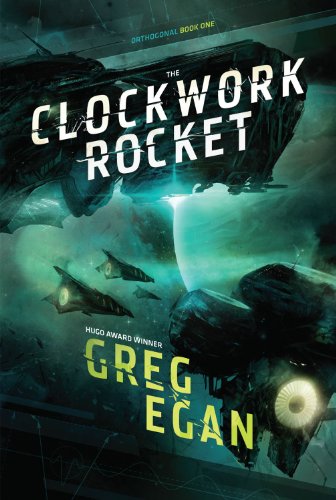
The Clockwork Rocket by Greg Egan has featured prominently in my posts about the books I look forward the most in 2011 (HERE and HERE). The start of the Orthogonal trilogy that takes place into a strange universe where matter is unstable, complex molecules have to be really complex - so the sentient beings that are the heroes of the series like Yalda in this book are six limbed shapeshifters with a strange reproductive biology for example - but people are still people so to speak and they have desires and motivation that we can empathize with...

Well, I just finished the book yesterday afternoon and I *had* to reread it immediately, so powerful it was. I put some very rambling thoughts on Goodreads that need editing at some point in the future and a full review will come here in due course - read those thoughts at your peril since while I do not think they are spoilery, I have to let a little time to pass to really think about this book unemotionally, since besides being a pitch-perfect example of sf and showing why sf is still my favorite genre even after 20+ years of heavy reading in it, the novel is very emotional as literature with characters we care about...

Anyway, while I saw the ending from a long way back it still made me almost cry in a way no sf has done so since the 2005 Honorverse novel At All Costs (FBC Rv) by David Weber whose ending is similarly emotional. Coming back to the Orthogonal trilogy by Greg Egan, the only thing I will add is that I *really, really* want the second installment...

********************************************************


The other novel I talked about in the two above mentioned posts (HERE and HERE) is the The Last Four Things by Paul Hoffman. Somewhat to my surprise, my dual review with Robert Thompson of The Left Hand of God is probably the single most read review of ours here at FBC based on the continual hits it gets daily and of course I am delighted since I *really* loved the book, bought for myself a final edition to complement the review copy I got and I kept inquiring about a review copy for this one for months now.
Link
Due to the quirks of publishing the book will be out in the UK soon, while the print US edition is scheduled for August, but it seems that - in a very wise decision imho - Penguin will sell the ebook in both UK and US (and presumably elsewhere) on April 28 if the Amazon listing HERE is correct.

To my surprise I have received a US edition review copy several days ago and with this the full five books in my original Top 5 Anticipated Post are accounted for - I read the other four and all were superb and will be top novels of 2011.

Needless to say I will get to this one next and will have some thoughts soon, though I have not decided yet when to do the full review. If the Amazon ebook listing holds, I will review it for sure later this month since the book is then officially available here too, otherwise I will see.

Edit 4/16 Some 1/3-1/2 in the book and it is as crazily inventive and good as The Left Hand of God, with the same alternating of styles, tones and narrative modes; there is considerably more backstory and world building and things make sense and hang together well, but the same "all but the kitchen sink" is thrown in and this one has some stuff that's even more outrageously funny than in The Left Hand of God and I found myself shaking with laughter often, though the book is also pretty dark and not for the easily offended.

The Pyramid of Lincoln and (the Bosco ordered forgery to save his and Cale's bacon) The Protocols of the Elders Moderators of Zion Antagonism are among the many early "pearls", and even more than in The Left Hand of God, The Last Four Things abounds with such play on the famous and infamous from history, always well done imho...
And there are battles, treachery, fights, blunders, deep seated plans that may or may not work...

Edit 4/18: About 100 pages to go out of 400+ and The Last Four Things has been all I expected and more; I would have easily finished the book in the weekend but I enjoy it so much that I do not want it to end so every 100-150 pages I reread them before going forward.

Even now and I have no real idea where it will go - I expect a particular ending to this one but who knows, the author keeps throwing surprises as well as underlining how the best laid plans just break because of stupidity, misunderstandings or pure chance. The "all but the kitchen sink" famous and infamous from history continues to delight and the book is just awesome - better than The Left Hand of God in some ways because it hangs things together and makes sense of the "big picture"...

Cale, Bosco, Vague Henry, Kleist and a few more new characters are shining - of course Cale first and foremost - but the rest have also great lines on occasion.

Edit 4/18 later I finished the book and while what I expected to happen, happened, the book went further, twisted again and left me a bit stunned and again without having much of a clue about what's going to happen in the 3rd volume; this time the author has a great two page explanation about his sources, including famous philosophers, Catholic thinkers, poets, obscure manuals of war that are available online and one (in)famous speech of Saddam Hussein (seems to be on YouTube) that *** cribs here before ***.

All in all The Last Four Things takes the promise of the Left Hand of God, fulfills it and more in a considerably more complex book this time with all the world building that was only hinted there, but keeping the narrative switches and the many twists, while the trilogy finale is something I really, really want asap...

Also this is another book like The Clockwork Rocket that will take a while to process, though here I am just somewhat stunned by the ending since the book kept getting darker and darker and went beyond emotion in some ways, more like say The Kindly Ones than the usual sff

********************************************************

LinkNote: So far this year my highly anticipated novels delivered in spades with The Clockwork Rocket and The River of Shadows being #1 in sf and fantasy for now - though to a large extent just because a book has to be number one - and with five more books: Leviathan Wakes, Naamah's Blessing, The Hammer, Embassytown and The Sea Watch on the same level for me - marked as 1-7 in my Goodreads list HERE they are for most part equals for me this year and the order is temporary, though the truly emotional ending of The Clockwork Rocket above and The River of Shadows (see the review) may keep those as #1.

Wednesday, April 13, 2011

Three More Books for 2011: Mann, Anderson, Ballantine/Morris (by Liviu Suciu)

Since for 2011 we have not done an extensive list of anticipated books as in the other years - though we have both the Upcoming Releases Page which tries to be comprehensive and the usual Monthly Spotlights which are closer to what we review here but still somewhat generic - I like to present some of the interesting upcoming releases that I had a chance to look into and even read sometimes, but for which full reviews are still some time off, these being books about which I can comment pertinently.

I also try and update these posts once I finish a book listed here and before I post a full review which supersedes the early and sometimes "rough" impressions, since I think continual feedback is useful and I see way too many posts: "oh, look at this exciting book that is coming soon" only not to be followed up with a review or even early impressions based on actually trying/reading the book.

**************************************************************

First on the list it is the The Immorality Engine from George Mann, the third Newburry/Hobbes adventure, following the Affinity Bridge (FBC Review) and The Osiris Ritual (FBC review). Since the US cover (Tor edition tbp in September) is just awesome and the author confirmed it to be final, I have to post it here in addition to the usual outstanding cover from the UK publishers (Snowbooks edition tbp June).


This was a huge expectation novel that was initially announced for 2010 and I kept pestering the author for a review copy since last fall until I finally got one a week or so ago and I read it basically the next day. I will have a full review in due course but for now a little commentary to whet your appetite and maybe you will try the first two books of this excellent and super fun series that combine the best of Sherlockian deduction, Bond-like adventure, steampunk late Victoriana with a little magic and necromancy too.

"The third Newbury and Hobbes adventure starts dramatically with a funeral of a favorite character and then goes back a week or so to its real start several months after the end of The Osiris Ritual to recount the events that led to said funeral.

The Immorality Engine has the same structure as the first two books - seemingly unrelated mysteries, this time the murder of a high-class jewel thief and an assassination attempt on Queen Victoria - which bring Maurice Newbury out from his opium descent after the events and especially the denouement of The Osiris Ritual which made him question everything about his life, job...

His stout friend Inspector Bainbridge and Newbury's assistant Veronica Hobbes - who intuits that she is at least partly the reason for his descent into full addiction, though unlike us, she does not know exactly why, but things are trickier as we learn during the novel - try desperately to "bring him back" and finally the case of the jewel-thief and later the deeper mysteries involved do so.

The usual combination of great character interaction, inventiveness and several villains that top all such to date plus a lot of moral ambiguities make The Immorality Engine a great culmination of the series to date ending its first arc on a superb note. I am really eager to see where the author takes the series next since the 6 - or even more - books planned seem to be on, though again I want to emphasize that each book tells a complete tale, while these three form a full thematic arc in the larger picture of the series.


**************************************************************


In July, Orbit will publish, The Key to Creation which is the final chapter in the Terra Incognita trilogy of Kevin J. Anderson. The series started strong in The Edge of the World (FBC Review) and continued even stronger in The Map of all Things (FBC review), so this volume is another huge expectation one for me and another one I've been trying to get a review copy for a while now, until finally a copy is on its way.

**********************************(cover may change)

A great cast of characters that you get to care about, superb world building and a lot of twists and turns made this series a favorite, though in true KJA fashion, nobody is safe and any character can die or be utterly changed at any moment. Who is going to survive, who is going to thrive, what will be the final resolution of the seemingly to-the-death conflict between the two people and two religions of the series, what role magic and the disappeared gods will play are some of the questions I expect will be answered here and as mentioned the expectations are really high...

**************************************************************

Finally a debut that I have just found out about and asked for a review copy since I liked the sample chapters, while the blurb is tempting and the cover is just irresistible. This is Phoenix Rising - A Ministry of Peculiar Occurrences Novel - by Pip Ballantine and Tee Morris, a novel that will be published soon by Harper Collins and which I expect to review here in a couple of weeks.

Here is the blurb, while on the authors' website you can find more including a cool trailer HERE.

These are dark days indeed in Victoria’s England. Londoners are vanishing, then reappearing, washing up as corpses on the banks of the Thames, drained of blood and bone. Yet the Ministry of Peculiar Occurrences—the Crown’s clandestine organization whose bailiwick is the strange and unsettling—will not allow its agents to investigate. Fearless and exceedingly lovely Eliza D. Braun, however, with her bulletproof corset and a disturbing fondness for dynamite, refuses to let the matter rest . . . and she’s prepared to drag her timorous new partner, Wellington Books, along with her into the perilous fray.
For a malevolent brotherhood is operating in the deepening London shadows, intent upon the enslavement of all Britons. And Books and Braun—he with his encyclopedic brain and she with her remarkable devices—must get to the twisted roots of a most nefarious plot . . . or see England fall to the Phoenix!

Tuesday, April 12, 2011

“Heaven’s Needle” by Liane Merciel (Reviewed by Robert Thompson)

Official Liane Merciel Website
Order “Heaven’s NeedleHERE
Read Fantasy Book Critic’s Review of “The River Kings’ Road

AUTHOR INFORMATION: Liane Merciel spent most of her childhood bouncing around the world as an Army brat. She has lived in Alaska, Germany, and Korea, and has gone camping in every one of the fifty states. Her hobbies include yoga, training rats, and baking cupcakes. Currently she lives and practices law in Philadelphia.

PLOT SUMMARY: The mountain fortress Duradh Mal, mysteriously destroyed centuries ago, has many legends, but only one truth. And now, in the shadow of that once-mighty fortress, something evil is stirring. Unaware of the danger, the high priest of the Dome of the Sun has sent two inexperienced Illuminers to the village of Carden Vale, at the foot of Duradh Mal, on what should be a routine tour of religious service. The warrior Asharre, strong and tall, her face scarred with runes, her heart scarred by the loss of her sister, is assigned to protect the young Blessed. But in Carden Vale they find unspeakable horrors—the first hint of a terrifying ghost story come true.

The Sun Knight Kelland, whose faith is his power, has been set free by the daring woman he loves, the archer Bitharn, but at the cost of undertaking a mission only he can fulfill. Joined by Malentir, a Thornlord steeped in the magic of pain, they follow the footsteps of the long ago ill-fated expedition to Duradh Mal. There lies the truth behind the frightening tales of the dead come back to life, flesh ripped from bones, and creatures destroying themselves in a violent frenzy. For a black magic that had been sealed for six hundred years has been unleashed, and now must be contained again—or an entire world will fall victim to a Mad God’s malevolent plague...

CLASSIFICATION: Where The River Kings’ Road offered readers a traditional, medieval European-influenced epic fantasy in the vein of Greg Keyes’ The Kingdoms of Thorn & Bone, David Farland and J.V. Jones, Heaven’s Needle is a horror novel wrapped up in fantasy clothing—think James Clemens’ Godslayer Chronicles and Tim Lebbon’s Noreela stories crossed with Clive Barker and H.P. Lovecraft.

FORMAT/INFO: Heaven’s Needle is 480 pages long divided over a Prologue, twenty-seven numbered chapters, and an Epilogue. Narration is in the third person via the archer Bitharn, the Sun Knight Kelland, the sigrir Asharre, and the entrepreneur Corban. Heaven’s Needle is the second novel of Ithelas after The River Kings’ Road, but is self-contained and only loosely connected to the first book. April 26, 2011 marks the North American Mass Market Paperback publication of Heaven’s Needle via Pocket Star Books.

ANALYSIS: Despite its conventionalism and failure to bring anything new to the genre, I really liked Liane Merciel’s The River Kings’ Road, which was an enjoyable fantasy debut that left me looking forward to the sequel. A sequel I became even more intrigued in after the author described her new book as a “fantasy-horror hybrid”. As a huge fan of both genres, I loved the idea of mixing horror with epic fantasy and was pleased to see the combination successfully executed in Heaven’s Needle.

Heaven’s Needle is the second novel of Ithelas, taking place a few months after the end of The River Kings’ Road. However, apart from the setting, a magic system based on the blessings of gods—Celestia, goddess of the sun; Kliasta, goddess of pain; Baoz, god of strength & war; Anvhad, god of treachery & deception—and returning characters in the Sun Knight Kelland and his companion/lover Bitharn, Heaven’s Needle has little to do with The River Kings’ Road. Basically ignoring what happened between Oakharn and Langmyr in the first book, Heaven’s Needle introduces a new storyline that finds Kelland & Bitharn joining forces with the enemy—Avele diar Aurellyn the Spider, leader of the Thorns (Kliasta’s disciples) and wife of the Baozite’s Lord Commander—in order to defeat an even greater threat in the Mad God Maol. Also caught up in this situation is Asharre, a sigrir—an ancient custom among the northern clans that allows a woman the rights of a man—accompanying two young Illuminers on their annovair, their first task as full Blessed.

The central premise in Heaven’s Needle is fairly simple, much the way it was in Liane Merciel’s debut, but it never becomes an issue thanks to competent writing, chapters that move along at a quick pace, and effective characterization. Of the characters, I enjoyed delving deeper into the minds of Kelland and Bitharn who remain caught in a heartbreaking struggle between love and duty, but it’s Asharre that really intrigues even though the internal conflicts (loss of a loved one, thoughts of revenge, finding purpose in life) she faces are familiar ones. Malentir, the Spider’s student, is another interesting character because of his dark powers and unknown intentions, while Corban is mostly a pawn although he plays a role in both Maol’s resurrection and defeat.

What separates Heaven’s Needle from its predecessor and other epic fantasy novels is the horror element. At first, Heaven’s Needle is more fantasy than horror with only a few hints of the true horror yet to come—ritual killings, an eyeflowers torture device, stories about ghosts & cannibalism, the crossing of Spearbridge (a bridge built from the items of people killed by Baozites which haunts all those who cross it with the last memories of the dead)—interspersed throughout the first couple of hundred pages in the book. Once the novel shifts to Carden Vale, Duradh Mal and Shadefell though, Liane Merciel really cuts loose, unleashing a dark and twisted imagination that includes such horrific things as the maelgloth—humans warped by the power of a god, their bodies grotesquely transformed—and the monstrous manifestation of Maol himself. At this point of the novel, the horror element takes center stage with even the prose conveying a sense of dread:

Its mouth gaped open so wide that its chin sank into the putrefying flesh of its chest. Its dessicated eyes rolled back in its head. The worm-like guts that she had glimpsed in its throat had pulled themselves into its mouth, where they pulsed like a mass of chewed tongues.

It hung there, a ghastly wound in the world, edged in bleeding wisps of black. All Bitharn saw within the gate was a wall of black and poisoned red, pulsing like an exposed heart through a mask of clotting blood.

Negatively, I was a little disappointed that the situation with Duradh Mal was left unresolved—Was the Maol infection completely eradicated? Why are the Thorns so interested in the Baozite fortress?—but as long as these issues are addressed in a sequel, it’s not a big deal, especially since the novel stands well on its own otherwise.

CONCLUSION: Fans of The River Kings’ Road will no doubt be surprised—and possibly disappointed—by the new direction Liane Merciel takes in her sophomore novel, Heaven’s Needle. After all, the new book has little to do with the author’s debut, while offering a much darker and more horror-driven reading experience. Of course, it’s for these very reasons that I found Heaven’s Needle to be much more engrossing than its predecessor. While I enjoyed reading The River Kings’ Road, it was a typical epic fantasy novel with few surprises, whereas Heaven’s Needle with its almost perfect mix of horror and epic fantasy provided something different and exciting. Granted, Liane Merciel took a major risk in writing a book that may alienate many of her fans, but in the process, I believe the author has improved her craft while coming a long ways toward finding her own voice. In short, I completely respect Liane Merciel’s decision to try something different and can’t wait to see what the author does next...

Monday, April 11, 2011

"Equations of Life" by Simon Morden (Reviewed by Liviu Suciu)


INTRODUCTION: I have vaguely heard of Simon Morden, mostly through his - informative, polite and avoiding the self-important smugness of others there - comments on Torque Control and possibly other related sites, so I was partly intrigued when his Samuil Petrovitch trilogy - Equations of Life, Theories of Flight (check the blurb at your peril since it is quite spoiler-ish for Equations of Life), Degrees of Freedom was announced from Orbit to be published in consecutive month releases, March-June 2011.

To be honest, the blurb below sounded like a try at reviving the dated and almost dead cyberpunk of the 90's, so it was only of middling interest, but I really liked the way Mr. Morden expressed himself in those comments and Equations of Life became a higher priority for me than it would have otherwise been.

"Samuil Petrovitch is a survivor. He survived the nuclear fallout in St. Petersburg and hid in the London Metrozone - the last city in England. He's lived this long because he's a man of rules and logic. For example, getting involved = a bad idea.

But when he stumbles into a kidnapping in progress, he acts without even thinking. Before he can stop himself, he's saved the daughter of the most dangerous man in London. And clearly saving the girl = getting involved. Now, the equation of Petrovitch's life is looking increasingly complex. Russian mobsters + Yakuza + something called the New Machine Jihad = one dead Petrovitch. But Petrovitch has a plan - he always has a plan - he's just not sure it's a good one."

OVERVIEW/ANALYSIS: Equations of Life took me by surprise and I found myself staying way, way too late to finish it in one sitting, so absorbing it was. On the surface the combination of standard cyberpunk/post-apocalyptic stuff seems both done to death and already dated, but this book just grabs one from the first page and never lets go and this is due to the style of the author and to the superb characters he creates:

Petrovitch first and foremost, a young almost-genius physicist, radiation scarred and with a weak heart that may kill him at any sustained effort, but the whole cast which contains Inspector Chain, the detective that investigates the attempted kidnapping mentioned above and related stuff, Sonja, the girl in the blurb, Madeleine, a big and strong young nun/bodyguard, member of a military Catholic order that has license to go armed and protect priests and churches from attacks, Sorenson, a dodgy American businessman and technologist, Oshicora, a very wealthy businessman/gangster/read the book to find out what more, who is an ultra-traditionalist Japanese trying to recreate at least virtually the now sunken under the waves Japan, while Sonja is his daughter with his English wife who is presumed dead in the disaster, his various minions,all Japanese survivors too, rival gangster Marchenko, a Stalin worshiper and gangster boss far-second to Oshicora in influence, who orders the kidnapping and provides lots of comic relief with his minions, Epiphany (Pif) Ekanobi, Petrovitch's fellow true genius scientist on the verge of proving a GUT and many more: assorted gangs, cafe owners, the priest protected by Madeleine...

Set in the 2020's in a future alt-hist diverging from ours in 2002 or so with Armageddon coming around that time - more about it is in the stories available free online - in the London Metrozone which is essentially the main governable part of England at the time, Equations of Life reads like a combination of JC Grimwood superb cyberpunk alt-history series (RedRobe, Remix...) with a dash of PF Hamilton Mandel series - this last one less in setting or tech, but more in general "feel".

So you will find a fast, furious novel with frantic action from the first page. While at first Petrovitch seems an innocuous character, a Russian student sponsored by a wealthy foundation who happens to have a somewhat shady past - though in the crazy world after Armageddon most people have something to hide - that makes him want to keep away from official attention, the author slowly reveals an unexpected depth, including the quite good reason that made Petrovitch take Sonja's hand and run with her when the kidnappers bungled the first attempt.

And from here the storyline is set since Petrovitch's options narrow quickly if he wants to survive the high stakes business he got entangled in and when some strange and seemingly unrelated disasters start affecting the Metrozone, his future looks even bleaker. But he has a plan and when that plan does not quite work the way he expected, he has another...

If there is a negative about Equations of Life (A/A+) is that despite that I enjoyed it a lot for its panache, I still cannot shake the feeling that I would have enjoyed it even more some fifteen years ago since sf moved from there. I plan to read Theories of Flight and Degrees of Freedom soon and review them together in a couple of months and while the trajectory of the second volume seems set from the ending of this one, already in the 50 odd pages I read there are some surprises that I hope will take the series beyond mundane into more interesting sf, so I will reserve a full evaluation until then. I truly hope the series will transcend its limited sub-genre since I really enjoyed the author's style and Petrovitch is just a great character, but three same cyberpunk novels are a little too much for me.