Official Felix Gilman WebsiteOrder "The Half Made World" HERERead FBC Review of ThundererRead FBC Review of Gears of the CityRead FBC Interview with Felix GilmanINTRODUCTION: With only two novels so far - the duology Thunderer and Gears of the City, both in my top novels of 2008 and 2009 respectively, at the time and now also - Felix Gilman has become one of the top-notch authors of interesting and unusual fantasies that mix the traditional and the strange. So despite knowing little about "The Half Made World" at the time, the book was a highly anticipated novel of 2010 and when the blurb below surfaced, my interest only grew:
The world is only half made. What exists has been carved out amidst a war between two rival factions: the Line, paving the world with industry and claiming its residents as slaves; and the Gun, a cult of terror and violence that cripples the population with fear. The only hope at stopping them has seemingly disappeared—the Red Republic that once battled the Gun and the Line, and almost won. Now they’re just a myth, a bedtime story parents tell their children, of hope. To the west lies a vast, uncharted world, inhabited only by the legends of the immortal and powerful Hill People, who live at one with the earth and its elements. Liv Alverhyusen, a doctor of the new science of psychology, travels to the edge of the made world to a spiritually protected mental institution in order to study the minds of those broken by the Gun and the Line. In its rooms lies an old general of the Red Republic, a man whose shattered mind just may hold the secret to stopping the Gun and the Line. And either side will do anything to understand how.FORMAT/CLASSIFICATION: "The Half-Made World" stands at 480 pages divided into five parts and 52 chapters, all named and with an epilogue that sets up the concluding volume of the series. The novel follows the POV's of its three main characters, Dr. Liv Alverhuysen, Agent of the Gun Credmoor and Sub-invigilator Grade 3 Lowry, with occasional flashback snippets that illuminate the larger picture.The first part of an intended duology, "The Half-Made World" is a fantasy set within a wild-west kind of mythology; with elements of both steampunk and magic "The Half-Made World" sits at the boundary between the more traditional adventure fantasy and the new weird. "The Half-Made World" stops at a very good point and offers a complete reading experience, though of course I really want to see where the story goes next.OVERVIEW/ANALYSIS:"The Half-Made World" is quite a strange book. It is dark and dense, but a page turner nonetheless that would not let go once I entered its flow. The known-world is divided between the settled East and the expanding into uncreation West. Some centuries ago the seemingly impassable mountains that formed the border of the settled world opened and people started settling the lands beyond and in the process fixing them into reality. However un-natural or supernatural things sprung out here and there, most notably spirits, demons and "magical" engines, while the local people of the "uncreation" who may be immortal and have magic are pushed farther and farther away, with the remnants enslaved.
The settled parts of the West consist of many independent lands but all live under the ever expanding shadow of the Line, a highly regimented industrial and well armed civilization of millions, led by the magical engines of above, currently 38 in number, that span tens of thousands of miles of tracks; opposing them are the Demon Guns and their agents, who are few - some tens, maybe a hundred - in number, but who have extreme powers of endurance and who foment uprisings, rebellions and generally wreak havoc wherever they think the Line is vulnerable.
Some decades ago a "free republic" has risen, led by a General who was rumored to have had a pact with one of the original natives and knew how to use their magic; nevertheless after 40 years of flourishing, the Republic was finally crushed by the Line and after 10 more years of underground resistance, the General was rendered mad by a Line "noise bomb" in his last stand and he was presumed dead.
However it is rumored that he is now a patient at an asylum on the farthest borders of the West with the uncreation, asylum that is neutral and under the protection of a powerful spirit; a letter surfaces hinting of an "ultimate" weapon the General may have been given by his native allies and both the Line and the Gun want it. Effective but unruly Gun Agent Credmoor is sent to infiltrate the asylum, while a thousands strong - with flying machines, poison gas, bombs, machine guns and the like - Line force is also dispatched to deal with the Asylum and their Spirit, with sub-invigilator, grade 3 Lowry as one of their officers.
Liv Alverhuysen, a psychiatrist from the far away settled cities of the East and with a traumatic past of her own, receives an invitation to join the Asylum staff - invitation actually addressed to her much older and recently deceased husband, but she figures out she would be gladly received too. She engages on the long and harrowing journey with her servant/protege, who is a relatively young man of her age, very strong physically but mentally challenged so to speak. And so it starts, with the three main characters above converging on the Asylum and then of course lots and lots of things happen.
What are the strengths of "The Half-Made World"? In the above overview I mentioned two - most notably its exquisite and quite original world-building which makes reading the book worthwhile on its own. And of course, the energy of the narrative flow that does not let go of the reader. The combination of story, action and descriptions are balanced perfectly and the continual switching between the three main threads is smooth.
There is also an interesting dynamic represented by the characters: Lowry is a devoted Line official, one in literally millions who has really never known life outside his mechanistic and grimy civilization, though he has participated as operative on Gun Agent hunts. So he is less of an individual and more of a cog in the machine.
Credmoor is the supreme individualist bonded with a Demon Gun whom he more or less has to obey in return for the immense physical benefits, but the Guns are quite anarchic too with essentially one purpose - wreak havoc to avoid the Line crushing them for ever... So Credmoor is both the "lone gunman" of the Wild West mythology, but also its outlaw.
Liv represents settled civilization and culture; sure she has her own traumas and the decision to go into the unknown shows she wants to "escape" the confines of her society, but overall she is the one clearly humane character of the novel. So we have the machine, the rebel and the explorer , though they are all quite memorable characters on their own too.
While "The Half-Made World" immerses the reader into its world, the author's superb writing style exerts its magic and the novel offers quite a lot, the big picture remains a bit murky to the end. There are tantalizing hints sure, the storyline and the fate of the main characters are more than enough reasons to strongly enjoy the book, but I was left wondering about the series' destination and even if there is such.
All in all "The Half-Made World" (A++ and currently my #8 fantasy and #13 novel of 2010 in a very strong year) is a powerful novel that confirms Felix Gilman as a master of the new weird fantastic.

Recently I decided to look back at the 2008 books I have read taking into consideration the ones I read later in 2009 or 2010, so 161 as of my last count. I put a top 25 list on Goodreads *based on my feelings today about the books* which I then compared to my FBC Top 2008 List.The FBC list is of course more elaborate - split into categories for example - but as a rough comparison the two lists make a good example of how books stay in my mind as time passes. The most notable difference is that Anathem which I thought a "once in a decade novel" upon reading it, faded very quickly and I never felt the compulsion to reread it, the way I did Spirit, 2666 or BSRA for example.To a lesser extent Caine Black Knife also faded in my memory, while Night Angel or The Engine's Child stayed strong as core-fantasy novels of 2008 go.I read Desideria, Omega and The House at Riverton in 2009 and those would have clearly made the list in 2008 as probably The Company would have done too, while several novels stayed in my memory much more than I expected at the time: The Magicians and Mrs. Quent, Empire in Black and Gold, Chaos Space, Red Wolf Conspiracy and The Immortal Prince.Here are the lists with links to the FBC reviews and when not available to my Goodreads mini-reviews. Since 2666 is on my list of top 00's novels and I plan to start reviewing big-time-favorites of mine from earlier years at least once a month - for October The Notebook qualifies and I hope to review either Use of Weapons or The Kindly Ones soon - I should have a full review of that one here.On Goodreads and current:
1: Spirit: The Princess of Bois Dormant, Jones, Gwyneth 2: 2666 Bolano, Roberto3: Desideria Kornher-Stace, Nicole4: By Schism Rent Asunder Weber, David5: Omega Evans, Chris 6: Night Angel Weeks, Brent 7:The Engine's Child Phillips, Holly 8:Anathem Stephenson, Neal9:Memoirs of a Master Forger Heaney, William aka Joyce, Graham10:The Gargoyle Davidson, Andrew11:The Magicians and Mrs. Quent Beckett, Galen M.12:Thunderer Gilman, Felix13:Caine Black Knife Stover, Matthew 14:The Kingdom Beyond the Waves Hunt, Stephen15:The Immortal Prince Fallon, Jennifer16:Empire in Black and Gold Tchaikovsky, Adrian17:The Company Parker, K.J.18:The House at Riverton Morton, Kate19:Serious Things Norminton, Greg 20;The Quiet War McAuley, Paul J.21:The January Dancer Flynn, Michael22:The Gift of Rain Eng, Tan Twan 23:Line War Asher, Neal24:The Red Wolf Conspiracy Redick, Robert V.S.25:Chaos Space (Sentients of Orion, #2) Pierres, Marianne de **********************************************************On FBC Originally posted in early 2009
SF:1) “Anathem" by Neal Stephenson. A once in a decade novel for me, the essence of sf. Reviewed HERE.
2) “Spirit: The Princess of Bois Dormant” by Gwyneth Jones. Count(ess) of Monte-Cristo in space. Reviewed HERE.
3) “By Schism Rent Asunder” by David Weber. Epic fantasy with an AI wizard. Reviewed HERE.
4) “The Quiet War” by Paul McAuley. Solar system space opera with a hard sf tinge. Reviewed HERE.
5) “The Temporal Void” by Peter F. Hamilton. Urban fantasy within a space opera setting. Reviewed HERE.
**********************************************************Fantasy:1) “Caine Black Knife” by Matthew Stover. Caine as a promising young star and his life 25 years later. Reviewed HERE.
2) Night Angel Trilogy by Brent Weeks. Individually, none of the books would make it in my Top 5, but as a whole it’s the best debut trilogy since Joe Abercrombie’s the First Law. "The Way of Shadows" reviewed HERE.
3) “The Engine's Child” by Holly Phillips. Most surprisingly superb genre novel for me; magical engineer girl lies, builds, loves. Reviewed HERE.
4) “Thunderer” by Felix Gilman. Music, gods, strange city, flying sea vessel. Reviewed HERE.
5) “The Kingdom Beyond the Waves” by Stephen Hunt. A sense of wonder adventure sf as epic fantasy. Reviewed HERE.
**********************************************************
Mainstream (fantastic)
1) “Memoirs of a Master Forger” by William Heaney (Aka Graham Joyce). Fairy tale for adults; superb, heart warming antidote to sadness and depression. Reviewed HERE.
2) “El Juego del Ángel” (Spanish language) by Carlos Ruiz Zafón. Dr. Faustus in Barcelona.
3) “The Gargoyle” by Andrew Davidson. Love and third degree burns across space and time. Reviewed HERE.
4) “The Ninth Circle” by Alex Bell. Redemption by forgetting.
5) “Ghost Radio” by Leopoldo Gout. DJ loves the supernatural and the supernatural likes him back. Reviewed HERE.
5) (tie) “Black Ships” by Jo Graham. Trojan priestess helps Aeneas found Latium.
**********************************************************
Mainstream (non-fantastic)
1) “2666: A Novel” by Roberto Bolaño. Another once in a decade novel; masterpiece of world literature.
2) “The Good Thief” by Hannah Tinti. Darker, adult version of Hector Malot’s classic “Nobody's Boy”. Reviewed HERE.
3) “Le Salut de l'Empire” (French language) by Claude Schote. The missing half of Alexandre Dumas' last novel finished by noted Dumas biographer Claude Schott based on the original outline, including some chapters written by Dumas. Hector fulfills his destiny.
4) “Sashenka: A Novel” by Simon Montefiore. Decadence and revolution in Tsarist Russia, romance and torture in Stalin's USSR.
5) “The Minutes of the Lazarus Club” by Tony Pollard. Victorian science and technology to kill for. Reviewed HERE.
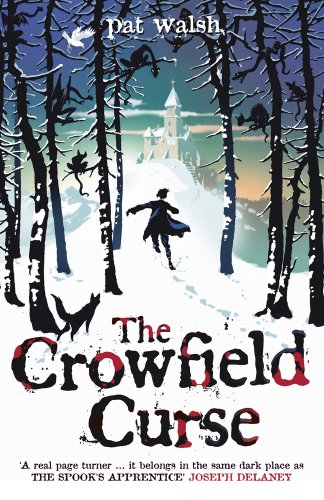
As I've mentioned one of my favorite things to do is to read some of the middle grade fantasy books. After all our interest in fantasy has to be sparked at some point in our lives. So I always will reserve a little time to read some of what is considered "Middle Grade" fantasy/Sci-fi. Here are two of my more recent reads, "The Crowfield Curse" by Pat Walsh and "No Such Thing As Dragons" by Philip Reeve.

The Crowfield Curse by Pat Walsh
Order Crowfield Curse from Amazon Here
The setting is 1347 and Will is an orphaned boy who is forced to work amongst the Crowfield monks. One day as Will is given the task of gathering firewood in the forest he comes across a small creature who has been wounded by a fox trap. Although the creature looks like a small cat it is anything but a cat it turns out to be a hobgoblin and not every human can see him.
As a favor to Will for rescuing him, the hobgoblin reveals a secret that the Abbey has been keeping for over 100 years. In the back of the abbey, buried deep below the ground is an Angel. This secret brings a lot of questions up for Will. How can an Angel die? What secrets does the Abbey hold that he doesn't know? What could be so evil to actually kill an Angel? And who is this strange man that is visiting the abbey when the abbey hasn't had visitors in years? Is Old Magic making a come back?
The Crowfield Curse was a bit of a mixed bag for myself. While the story and plot seemed interesting, the novel was written in a very middle grade style. The font in the book is huge and the chapters are about 5-10 pages long making this a really quick read.
So here is what made Crowfield Curse a mixed experience for myself. First, the novel starts off very slowly. It details things that I had already learned on the back flap of the book. It wasn't until the halfway point that readers were introduced to other elements outside what was already told. Once those elements were given the book really did pick up. The characters have a bit of personality but don't expect anything too deep or detailed.
What I really enjoyed about Crowfield Curse was the mixture of a medieval setting, the fey and Christian themes. While the Christian themes were spread throughout the novel, it didn't seem forced and really worked for the story. I thought the whole last half of the book was a unique twist and combo of Old Magic and fey stories.
If you are looking for an easy read or children's story that is fairly well written, then Crowfield Curse will give you that. It is a first book of a series and I look forward to what Old Magic will be springing up on Will in the next novel.
The Crowfield Curse stands at 336 pages and was released September 1, 2010 by The Chicken House, a division of Scholastic. It is a mixture of medieval abbey, mystery, old magic and Christian lore.

No Such Thing As Dragons by Philip Reeve
Order No Such Things As Dragons from Amazon Here
Ansel is a mute boy who is sold by his father to a dragon hunter. Ansel has been mute ever since his mother died a number of years ago. Brock is the dragon hunter who goes from village to village in shiny armor, telling tales of how he destroyed dragons and hunted them down. Although Brock tells these villages that he hunts dragons, everyone knows there really is "no such thing as dragons".
While Brock takes Ansel to a small village in an effort to dupe a village into believing he is hunting dragons, Brock and Ansel run into a mysterious creature that really does look like a dragon. But it can't be a dragon, because dragons don't exist..... or do they?
No Such Thing As Dragons is 192 page novel that was released September 1, 2010 by Scholastic, Inc.
I'm a dragon lover and have been for a while. Give me any book with a dragon and I'll read it. I've even been known to read picture books with dragons! However, this novel just didn't do it for me. Here's why.
There is a lot of emphasis on religion. While it didn't bother me, it was really packed in there. I sorta felt that, the time that was focused on religion could have been spent on something else like developing characters. I just don't believe in a book that is geared for grade 4 through 6 there should have been such an emphasis on God and the Devil and why these things were part of the Devil.
The major drawback for myself was that this whole book was almost told to the reader. It didn't feel as if I was experiencing the story with the characters and instead I was told what had happened to them. There is very little dialogue and at one point in the novel it jumped between 4 different characters in a 2 page span. It just seemed like so much was packed into the novel in such a short space.
The good parts of the book were the descriptions of the travels. Such as when the characters were on the mountain. I loved the descriptive feel of the book and just wished that there was some dialogue mixed in with it.
This is definitely a short, quick book for young readers. There isn't anything that really stands the book out from any other books about dragons but it would be a great intro reader for younger readers looking for a mystery and easy read.
 Official Jon Connington WebsiteOrder "Skywatcher" HERE (Kindle) or HERE (multiformat ebook)Read About a Quarter the Novel HERERead FBC Review of Field of FireINTRODUCTION:I found out about the author's debut Field of Fire from a review inquiry for FBC and I liked the book so much that its conclusion, Skywatcher became one of my top awaited books of the second half of 2010. Sadly after a pretty strong novel almost to the end, the author blunders badly and takes the book and series one notch down.Armies gather on the horizon. A world on the edge of destruction A hero faces the ultimate choice.Driven onward by his quest for revenge, Macsen has come the Kingdom of Audran, There he joins with the Order of the Skywatchers to bring down Goren, the mage responsible for the destruction of his village. Armies gather in the wilds of the Upper Airs, as Goren readies the final step of his plan to destroy the world and then remake it in his image. Battle rages in the killing skies, swords and magic clash. And the fate of the world lies in the hands of one man.
SKYWATCHER: the thrilling conclusion of The Storm at the Center of the World!FORMAT/CLASSIFICATION: "Skywatcher" stands at about 325 pages and has two main threads. The main storyline follows Macsen and Zofera whose paths meet as expected when Macsen comes to Vorsenn.The second thread follows Goren (aka Ornezo) whose failure to plunge the continent of Tamistal in flames by intrigue, leads him to use direct force by uniting the equivalent of barbarian tribes of the story that live in the inhospitable Upper Air and bringing them to pillage and kill freely in the middle realms. "Skywatcher" is fantasy adventure and the second installment and conclusion of the Storm at the Center of the World series.
OVERVIEW/ANALYSIS: Skywatcher picks up where Field of Fire ends and continues the saga of Macsen, Zofera and the renegade mage Goren to the end. The writing is very energetic and there are a lot of cool descriptions and action scenes, though the story is predictable. The author carries it with panache but the ending is quite disappointing and takes away from an otherwise great series, so overall the duology is less than I expected based on the first volume; sometimes you need to be able to maintain the emotional balance, not only the story pace and here the book fails.
It is very hard to avoid spoilers in discussing why I think the ending diminishes the novel a lot, but the strength of the series are in its exuberance and "over the top action scenes", rather in any "realism" - after all it has floating countries, good pirates, wise mages - so while the novel has drama and some dark moments, they are clearly "make-believe" and there is no moment in which the heroes are in real jeopardy, though the author's writing skill keeps the suspension of disbelief going strong.
This is of course part-and-parcel why Field of Fire and Skywatcher for most of its length are so entertaining, rather than a negative, since this is where the series stakes its territory from the beginning. So there is an emotional balance, not only a storyline one and breaking it at a given point is just arbitrary rather than edgy, so to speak. You can pull off the ending of Skywatcher - and for example Ironroot by SJA Turney does very successfully something similar though in a different context - but you need to adjust slowly the balance throughout the book, rather than dropping the axe so to speak at the end.
Incidentally, if the author is determined to end the book the way Skywatcher does, still abruptly and without any adjustment, there is another possibility by carrying the story forward in time with an epilogue and doing it there, which is more acceptable and has been done in quite a few of my favorite novels like say The Player of Games or even SJA Turney's debut fantasy Interregnum.
Skywatcher (B) was what I expected and more almost to the end, but then the author dropped the ball badly in misjudging the emotional balance of the novel and while it did not quite ruin my experience of the series, it definitely took it a notch down.
 Agota Kristof at WikipediaOrder the Trilogy (The Notebook, The Proof, The Third Lie) HERERead from The Notebook on Google BooksINTRODUCTION: Recently, a copy of Agota Kristof's trilogy found its way to me and on opening it, I was just blown away by the first several pages. The trilogy contains one short novel that should be a "new classic" of our times - ok the late 1980's when it was first published. This is The Notebook which is just mind blowing and utterly original - very dark, graphic and explicit so not for everyone but awesome nonetheless and I found myself alternately laughing out loud and being quite shocked by its twin boys' narration.
The Proof that directly continues The Notebook and The Third Lie that reinterprets all that came before are excellent too, but they are a bit superfluous and The Notebook should have been left on its own. The other two novels are more conventional with stuff we have seen before - still dark and occasionally explicit - and they cannot help but lessen the impact of The Notebook since the stark - short sentences, short chapters - structure of The Notebook as it befits its children POV(s) is just un-replicable in more common tales like the next two.
FORMAT/CLASSIFICATION: In the easily available 1997 Grove Press English edition linked above that contains all three novels, The Notebook takes the first 185 pages or so out of a total of some 480. It is divided into 64 short chapters, each written in very short but precise sentences by the twin boy narrators. The chapter titles are descriptive: "Arrival at Grandmother's", "Our Chores", "Exercise to Toughen the Mind","Exercise in Begging", just to give some of the most memorable ones but each name is quite important in what follows.And for completeness, I will add that the following books change structure considerably, with The Proof that immediately follows the events in The Notebook, divided into eight numbered parts with third person narration from essentially one POV, while The Third Lie is divided into two parts, each narrated by one character. The Notebook is another novel that is hard to classify; on its surface it is a tale of survival among the horrors of total war, but it is much more than that, being also a novel of discovery as the boys try to make sense of the "grown-up world" that seems to have gone mad around them.Note: The Notebook has been translated from French by Alan Sheridan, The Proof by David Watson and The Third Lie by Marc Romano.OVERVIEW/ANALYSIS: The Notebook takes place in an unnamed Little Town on the border with "our side" where the twin narrators are brought to "Grandmother's House" by Mother from Big Town to escape the daily bombardments and the shortages. It is easy to place names and dates (eg Big Town is Budapest, the border is with Austria and so on), but the intended vagueness in names and places work better in reinforcing the universal themes of the novel. The use of capitalized common words for names: "The Postman", "The Cobbler"... also adds to the authenticity of the children's POV narration and is another great touch.
"We start writing. We have two hours to deal with the subject and two sheets of paper at our disposal.
At the end of two hours we exchange our sheets of paper. Each of us corrects the other's spelling mistakes with the help of the dictionary and writes at the bottom of the page: "Good" or "Not good." If it's "Not good," we throw the composition in the fire and try to deal with the same subject in the next lesson. If it's "Good," we can copy the composition into the notebook. To decide whether it's "Good" or "Not good," we have a very simple rule: the composition must be true. We must describe what is, what we see, what we hear, what we do.
For example, it is forbidden to write, "Grandmother is like a witch"; but we are allowed to write, "People call Grandmother the Witch.
It is forbidden to write, "The Little Town is beautiful," because the Little Town may be beautiful to us and ugly to someone else.
Similarly, if we write, "The orderly is nice," this isn't a truth, because the orderly may be capable of malicious acts that we know nothing about. So we would simply write, "The orderly has given us some blankets." We would write, "We eat a lot of walnuts," and not "We love walnuts," because the word "love" is not a reliable word, it lacks precision and objectivity. "To love walnuts" and "to love Mother" don't mean the same thing. The first expression designates a pleasant taste in the mouth, the second a feeling.
Words that define feelings are very vague. It is better to avoid using them and stick to the description of objects, human beings, and oneself, that is to say, to the faithful description of facts.""
The excerpt above which is more than half of the chapter "Our Studies" is in some ways the "heart of the novel" and it both gives a clear example of its style and of its theme with detachment and "distant analysis" being the mode of protection our heroes adopt in the face of the mad world. Though the extract is quite benign, considering the darker happenings in other parts of the novel and the explicitness that may shock readers - explicitness that is described factually as being what the narrators see, without comments or interpretations. Or maybe this matter of fact acceptance is what's shocking.
Slowly the boys develop a "moral sense" that guides their actions and which is quite rational considering what's going on around them and that is another of the elements that elevate The Notebook beyond its original story. There is action and there are moments that will chill, thrill or shock you, but the novel is darkly funny most of the time despite its content. While it has a seemingly small and remote location, The Notebook is peopled by quite a few distinctive characters whose interactions with the narrators range from mundane to weird. Grandmother, The Priest, The Orderly, Harelip and The Housekeeper are the ones that stuck most in my memory. The ending is perfect and while the story continues in the next two books, that was not really necessary.
The Notebook (A++) is one of the most powerful and unusual novels of contemporary literature.