Thursday, April 21, 2011

“To Hell and Back: The Damned Busters” by Matthew Hughes (Reviewed by Robert Thompson)

Order “The Damned Busters” HERE (US) + HERE (UK)
Read An Excerpt HERE

AUTHOR INFORMATION: Matthew Hughes has made a living as a writer all of his adult life, first as a journalist, then as a staff speechwriter to the Canadian Ministers of Justice & Environment, and lastly as a freelance corporate and political speechwriter in British Columbia. His bibliography includes the Archonate novels, the Tales of Henghis Hapthorn, The Commons, Template and numerous short fiction. He also writes crime fiction as Matt Hughes and media tie-ins as Hugh Matthews. The Damned Busters is the author’s Angry Robot debut.

PLOT SUMMARY: After accidentally summoning a demon, the mild-mannered Chesney Anstruther refuses to sign the contract, causing Hell to go on strike. But with no demons to tempt mankind, the world becomes a strange and boring place. To settle the strike, a deal is struck between Satan and Chesney, and thus the strangest superhero duo ever seen—in Hell or on Earth—is born!

CLASSIFICATION: The Damned Busters is a whimsical PG-13 urban fantasy novel that combines the supernatural and superheroes with comedy and romance.

FORMAT/INFO: The Damned Busters is 340 pages long divided over twelve numbered chapters. Also includes an interesting Afterword about how the author landed at Angry Robot with his series To Hell and Back. Narration is in the third-person, exclusively via the protagonist Chesney Arnstruther. The Damned Busters is self-contained, but is the first volume in the To Hell and Back series, which has a sequel—Costume Not Included—scheduled for publication in 2012. May 5, 2011/May 31, 2011 marks the UK/North American Mass Market Paperback publication of To Hell and Back: The Damned Busters via Angry Robot. Cover art is provided by Tom Gauld.

ANALYSIS: The Damned Busters is a novel that immediately caught my attention simply because it was written by Matthew Hughes. In fact, the only thing I knew about the book going in was that The Damned Busters was the author’s first attempt at writing urban fantasy. Urban fantasy is a genre I’ve all but given up on, but I had faith that Matthew Hughes would not let me down and I wasn’t disappointed...

The Damned Busters gets off to a fast start with the protagonist Chesney Arnstruther accidentally summoning a demon from Hell, while Chesney’s amusing interactions with various inhabitants of Hell and details about the protagonist’s peculiar personality and background—loves mathematics; works as an actuary at Paxton Life and Casualty (PL&C); uses “strings of nonsense syllables” in place of profanity (follyfluke, ding-dabble, blue bling blithers); hobbies include reading superhero comix and playing poker; described as “severely introverted”—quickly establishes the novel’s whimsical nature. Where things really start to get interesting though is after Hell goes on a strike because of Chesney’s actions:

“Greed, anger, lust, gluttony—indeed, all of what used to be called the ‘seven deadly sins’—have suddenly stopped affecting our conduct. It’s as if, after having spent all our lives with a devil and an angel on each shoulder, none of our devils are showing up for work.”

The result is a world quite different from the one I had imagined if all evil was suddenly eliminated. A world that Chesney succinctly describes as “Meh. That’s what it is. Not good, not bad, just meh.” To help resolve this situation, Chesney enlists the aid of Reverend Billy Lee Hardacre—a television preacher who was once a successful lawyer and bestselling author—to act as a mediator between Satan and the Infernal Brotherhood of Fiends, Demons and Tempters (IBFDT). The solution they come up with revolves around Hardacre’s interesting theory that everything—“Heaven, Hell and everything inbetween”—is just the draft of a book that God is writing and Chesney’s unprecedented deal with Satan in which he gets to command a demon for two hours out of every twenty-four in order to “fight crime and bad guys.”

At this point, The Actionary is born and The Damned Busters ventures into more familiar territory where superheroes, droll comedy and awkward romance all collide. In short, imagine a quirky indie film starring Michael Cera crossed with the likes of Kick-Ass, Defendor and Super, but without the graphic violence and narcissism. Of course, there are a number of factors that help distinguish The Damned Busters from the competition, one of which is The Actionary’s powers. Changing into his costume, night vision, hyper speed, strength of ten, teleportation, appearing at a crime before it happens . . . Chesney can accomplish all this and much more by simply issuing a command to Xaphan—a saber-toothed, weasel-faced demon who talks and dresses like a gangster and is addicted to rum and cigars.

Another key factor is Chesney himself. A borderline autistic with practically no social skills, Chesney Arnstruther is not the kind of person one envisions as a superhero, but it’s these eccentric qualities that make him unique and endearing. Like the way he’s always questioning himself about whether or not his actions and comments are socially acceptable, resulting in some fascinating and entertaining conversations, especially with the opposite sex.

Matthew Hughes’ writing meanwhile, is superb throughout with clever prose—“So imaginative were her renditions of the sufferings of the damned that, in another life, she might have won renown as an author of fictions meant to chill the blood and shiver the spine. But fiction was far from Mrs. Arnstruther’s mind as she described the impalings, amputations, roastings, piercings, gougings and rough penetrations into intimate parts that awaited her correspondents. To her, these torments were as real as breakfast. And her contemplation of their visitation upon the recipients of her missives, far from causing her chills or shivers, always brought a rosy glow to her rounded countenance.”—amusing dialogue, and brisk pacing making it feel like I was reading a book by Dean Koontz and Terry Pratchett.

Overall, To Hell and Back: The Damned Busters is a damn good book. Chesney Arnstruther is a uniquely charming protagonist; the plot is immensely entertaining, full of wit, humor and heart; the ideas presented are original and thought-provoking; and Matthew Hughes’ writing is skillful and engaging. Best of all, The Damned Busters is a blast to read and not quite like any book I’ve ever tried before, instantly making the sequel one of my most anticipated releases of 2012...

Wednesday, April 20, 2011

"Embassytown" by China Mieville (Reviewed by Liviu Suciu)


INTRODUCTION: When I hear the name China Mieville, I always think of the genius author that took fantasy by storm with two masterpieces that reshaped the more outlandish parts of it and by their extraordinary success gave commercial viability to a new sub-genre that came to be known as New Weird.

The books in questions are Perdido Street Station and The Scar, and they are among my top all time standalone fantasy novels. I reread them quite a few times and I see myself rereading them for a long time to come. The unbridled imagination exhibited in both is just breathtaking.

The third New Crobuzon novel, Iron Council, was a book that I almost hated, though in time I came to view it as a perfect example of the "well written but empty" novel; many people from the sff scene whose opinion I deeply respect told me that "Iron Council" is a masterpiece of novel composition, and while it may be so technically, for me it still remains a soulless book that throws away the rich milieu of New Crobuzon by repetitiveness. I'd rather have a flawed book, warts and all, that I care about than a perfect novel that leaves me cold and wondering why I bothered...

After a YA novel Un Lun Dun, Mr. Mieville returned to the genre with "The City and the City", a police procedural with a twist and a book I would have appreciated more were I new to the mystery genre; sadly this genre is limited and across time I read too many books from it so the genre essentially is finished for me and consequently the second part of "The City and the City" where the speculative elements from the first part fade away was a huge letdown.

Next came Kraken from another subgenre I dislike, namely Urban Fantasy and while I read some 200 pages from it, I lost suspension of disbelief, got bored and stopped and I am not sure when I will finish it. But now we finally have a China Mieville novel of the kind I love and Embassytown has been one of my top five expected books from 2011.

"Embassytown: a city of contradictions on the outskirts of the universe. Avice is an immerser, a traveller on the immer, the sea of space and time below the everyday, now returned to her birth planet. Here on Arieka, humans are not the only intelligent life, and Avice has a rare bond with the natives, the enigmatic Hosts - who cannot lie. Only a tiny cadre of unique human Ambassadors can speak Language, and connect the two communities. But an unimaginable new arrival has come to Embassytown. And when this Ambassador speaks, everything changes"

OVERVIEW/ANALYSIS: In a strange universe, there are even stranger things than "subspace" travel, multiple human habitats and the vast unknown and its rumors. At one end of the subspace "corridors", isolated from the rest of the universe by the "Wreck", there is Arieka, a planet of sentient beings for which Language is organic and essential to their sentience as well as literal in their understanding of the world - so for example they cannot lie, they cannot understand machine talk however perfect in reproducing their sounds and they cannot understand humans unless the humans mimic the aliens physicality of speech in the person(s) of the Ambassadors.

So despite their bio sophistication, the Hosts - as the aliens are called by the inhabitants of Embassytown the human city/outpost on their planet - are less sophisticated than the experienced human operators both native and "colonial" since they cannot literally conceive of various things; add to this politics, intrigue and simple unintended consequences of inter-human power plays and we get this superb novel that partly explores the same narrative space as The City and the City but in a far more imaginative and interesting way.

The novel is narrated by Avice, an Embassytown native who as a child attracts the attention of the Hosts and is offered the role of a human simile in the aliens' strange culture. Despite the pain and discomfort involved, Avice accepts and she becomes forever part of the Hosts "language" as "a girl ate what was given to her".
In return, the colony powers - the weird humans known as Ambassadors and their staff - approve her "immerser" application and she becomes a qualified starship crew and leaves Embassytown for the larger universe. In a fast whirlwind tour we get a glimpse of the intricate creation by the author, until for various reasons Avice somewhat unexpectedly returns home and soon becomes involved in the events that will shake the world to its core.

The structure of the novel is nonlinear for the first half so we move between the present of the crisis and the past as narrated by Avice, but once things get going in earnest, Embassytown becomes in large part a typical example of sf about aliens with a strange biology that makes their interaction with humans tricky and to be managed carefully, the humans' misstep - by chance, mistake, malice - the consequent imbalance and tottering on disaster and the solution if any - and there is indeed such sf where there is no solution and the planet in cause goes boom at the end.

Very familiar stuff from tons of sf novels, executed perfectly by the author, but quite predictable in many ways as the big picture goes; from a pure sfnal point of view the least sf you've read the more you will appreciate the novel and it will keep you in suspense. On the other hand as a literary achievement, Embassytown is superb and for me that was enough to greatly enjoy the novel despite reading its sfnal content of the second half for the nth time.

I really loved the glimpses of the larger universe of the novel and I wish that the author will expand them in a series of novels set there - the ending of Embassytown offers a great hook for that, but there could be something completely unrelated - while the main action of the book is handled masterfully, however the main strengths of the book are in language and characters.

The book just flows perfectly and you cannot stop turning its pages, while the cast is just superb. Outside Avice, the main characters are the Ambassadors CalVin and EzRa, her husband Scile - a semi-professional non-native linguist whose fascination with Avice's home-world partly led to their return - various other human similes as well as several Hosts that slowly start taking center stage as the novel progresses.

Avice's journey from a young naive child, to a jaded former spacewoman at the margins of the power centers of Embassytown and then to her becoming central in the action when the crisis comes and both Ambassadors and colonial representatives are passed by the events spinning fast out of control, forms the narrative axis around which the novel revolves and I think this choice paid off big time since it kept the book unitary.

Above I mentioned three major aspects of the novel - the outside universe, the aliens culture and its biological underpinnings, the humans' interaction with them - and there are several more which are somewhat peripheral though they have their roles in what happens - most notably the power play between the humans of Embassytown and their leaders, the Ambassadors, versus the colonial masters in the far away Bremen - and Avice is the main glue that keeps them in a whole.

Overall, Embassytown (A++) is a superb literary achievement of the author set in an imaginative universe with fascinating aliens, though the sfnal content is relatively predictable in the second part of the novel when the action starts centering on the human-Hosts interaction, rather than the aliens themselves or the humans by themselves for that matter.

Monday, April 18, 2011

Interview with Kevin Hearne (Interviewed by Mihir Wanchoo)

Order “Hounded” HERE
(Photo Credit: Kevin Hearne)

Amongst the various genres which I read, I’m always fascinated by Urban Fantasy. I think it’s due to the juxtaposition of the magical with the mundane world which gives most readers—including me-a reading high of sorts. In this sub genre, things are often competitive as there are only so many legends and mythologies which one can utilize and so it is always fun for me to discover new authors who manage to subvert old plots with new twists and/or take upon lesser-utilized mythos. One such person is debut author Kevin Hearne who snagged my interest when his book series, The Iron Druid Chronicles, was announced last year. I managed to get my hands on the first three books in the series—Hounded, Hexed and Hammered—which I’ll be reviewing in the forthcoming weeks. I really enjoyed the novels and immediately wanted to know more about the author behind the books. So I’m deeply grateful to Kevin Hearne who graciously agreed to answer the questions amidst his hectic work schedule and to Robert Thompson for his help with some of the questions. Now onto the interview with the man whose vivid imagination has flowered quite a tale set in the Arizona desert…

Q: Thank you very much for agreeing to participate in an interview. To begin with, could you introduce yourself for our readers and tell us what set you on the path of a writer?

Kevin: I love to read and write; I teach American Lit for my day job. What got me interested in writing was Ken Kesey’s novel, One Flew Over the Cuckoo’s Nest. It was such a brilliant example of what can be achieved through point of view and voice. It spoke to me like no other book had done before, and I wanted to tell stories with a voice like that. All of my favorite books are first-person narratives with extraordinary voice—To Kill a Mockingbird, The Adventures of Huckleberry Finn, and so on.

Q: You have set your series in Tempe, Arizona. I cannot say that I’m a seasoned Urban Fantasy reader, however I don’t think there is much Urban Fantasy set in Arizona. What prompted you to choose this particular setting besides it being your native state?

Kevin: Familiarity was certainly part of it, but since my main character is a Druid hiding out from the Fae, a desert seemed like a good place for him to hide. And I also thought readers might be ready for some stories outside of New York and L.A.

Q: Could you elaborate more on the journey you went through in finding a publisher, what you think of Del Rey, and what you think they saw in your book?

Kevin: I started writing in college and I’m “self-taught” in the sense that I never attended a writing conference or took classes. I must have begun three or four novels and never finished them. My first completed novel took me six years, and I kind of knew from the start that it wasn't very good, but I submitted it anyway and got rejected quickly. I shrugged it off as a training novel, because the hugely important lesson that I learned from it was that I could finish writing one. My next book was an epic fantasy; it was twice as long and only took me half the time. I actually got some nibbles on that one, but while it was out on submission I got the idea for Hounded.

I’d been reading a lot of urban fantasy and thought perhaps it would be fun to drop a Druid into the modern world. The odd thing was how fast I wrote it compared to the others; it took less than a year. I sent some queries out to agents, an intern found me in the slush pile, and I had representation in about six weeks. Once my agent submitted Hounded, he got very positive responses and we sold it at auction to Del Rey. Who, of course, are simply fabulous to work with; as far as what they saw in my work, my editor says what grabbed her was the voice, so that made me very happy.

Q: How do you plan on celebrating your first book which is published on the 3rd of May?

Kevin: I’m going into a bookstore and taking a picture of it on the shelf, because seeing something I wrote in a bookstore has been my dream for twenty years now. I’m going to buy it, sign it, and give it to the person working at the register. Then I’m going to go have a beer at an Irish pub. I’m having a launch party on May 9 at Changing Hands bookstore in Tempe, and the festivities after that will be a bit more extensive.

Q: Since Hounded is your first published novel, what did you think was the most challenging part about writing the book? What about the easiest or most rewarding?

Kevin: Anything involving police procedure is challenging for me, as are the fight scenes. I don’t watch crime drama and I don’t fight, so those bits take quite a bit of work on my part. The easiest bits (and the most fun for me) are slipping in allusions to literature.

Q: So when and how did the idea for The Iron Druid Chronicles first come about, how long have you been working on it, and how much has it evolved from its original conception (if any)?

Kevin: The idea was spawned in the spring of 2008. I was reading a lot of urban fantasy at the time and was trying to figure out a way to contribute to the genre that hadn't already been done. A male protagonist seemed like a good idea, since there weren't many males on the scene back then (and there still aren’t). And then, I confess, I wanted a hero who could talk to his dog, because I’m a dog person and I’ve always wished I could do that. Once that was decided, it kind of grew organically based on my own love for Celtic myth: My hero would be a real Druid who could tap the magic of the earth and talk to animals if he wished. So I did a wee bit of market analysis at the front end to find an unoccupied niche in urban fantasy, but this whole thing really snowballed once I put names to Atticus and Oberon.

Q: Speaking of the series, how many volumes are projected, how far along are you in the next book, and is there anything you can tell us about books 4 & 5?

Kevin: As of this moment, I’m not under contract for anything past Hammered. If the first three books do well, I’m shooting for either seven or nine volumes. Eight is simply impossible, so is ten, and eleven seems unforgivably long. I’m 40% through book four right now, hoping that people will dig the first three and tell all their friends. You can keep track of where I’m at on my blog; I keep progress meters on the sidebar (right hand side column). Book four will be called Tricked and book five is called Trapped.

Q: In the fantasy genre, cover art has always been a hot topic, especially how important it is in selling books. How do you feel about the covers for your books and what are your thoughts on the difference between Urban Fantasy covers from say “Paranormal romance”, et cetera?

Kevin: I love my covers, and Del Rey was an absolute dream to work with in that regard. My editor and I actually put together a piece on the creation of the cover for Hounded. Here’s the link for it if you’d like to check it out. I think UF covers tend to feature more weapons and slightly more clothing than paranormal romances do, and I definitely pushed to make sure Atticus was fully clothed on the cover.

Q: What are some activities or hobbies you enjoy?

Kevin: I collect comic books; I paint canvases and miniature models; I catch Shakespeare plays whenever I can; and I hug trees, both literally and figuratively.

Q: Your world is a melting pot of multiple mythologies; usually most books are centered on a singular mythology. What was the thinking process behind this move?

Kevin: It’s easy for people to point at someone else’s beliefs and say, “Hey, somebody just made that up a long time ago,” but not so easy for them to admit their own beliefs were made up too. The idea here is that yes, all the gods are made up, but that means that they’re all equally real, all equally valid. And I’ve been having tremendous fun playing with the idea that just as governments derive their powers from the governed, so do gods derive their powers from their worshippers. The true power is on the worshippers’ side. But if all these gods are real and still kicking today, why don’t we see them? Because on a fundamental level, we don’t believe we can. The gods are supposed to stay in Asgard or on Olympus or wherever, and so they do. Whenever they walk the earth, we filter it out because it simply can’t happen. Our faith is truly powerful—both in terms of what we believe in and what we don’t.

Q: You once mentioned that you have a secret affection for hand drawn maps. Can you tell us a bit more about this fascination for maps and will you be making one for your books?

Kevin: I do love maps, and if I ever whip my epic into shape it will have a map, by golly, a proper map. For now, there is a hand-drawn map of Asgard in Hammered, presented in-text as something Atticus draws for the benefit of others. I am not afraid to share that I’m geeking out about it. It’s just a little thing, but I did it myself, and I love it.

Q: Atticus’s tale seems a bit contained in just three books. What are your plans to take the story forward from there?

Kevin: Oh, there’s plenty more story, believe me. While the story arc involving a certain Norse thunder god is resolved in Hammered, it creates a bevy of new problems for Atticus, and he’s warned about those problems by a couple of different deities. Right now I’ve plotted through book six. He stays in Arizona for book four, but after that he’s out of the U.S. and hopping around the world quite a bit. What causes him to do that I’ll have to keep secret for now!

Q: As you mentioned, you are a big comic book fan and that was apparent throughout the anecdotes in your books. Which comics are your favorites?

Kevin: Growing up I was a huge Spider-Man fan. But somewhere along the way Marvel came out with fifteen different titles or so and I couldn't keep up, so I dropped it. I also might have matured a wee bit from age seven to twenty-two, I don’t know, and I was looking for more than dudes in tights. So when I returned to comics after a hiatus in college, I discovered The Sandman and saw how comics could be relevant for adults and even hold literary merit. Frank Miller’s The Dark Knight Returns remains a masterpiece, for example. And damn, just look at what Alan Moore has done. These days I read Northlanders and Chew.

Q: In your Suvudu post about “Considering the audience” you have listed Tabasco, freckles and strawberry lip gloss amongst the list of things you dig but rarely see, so what fascinates you about these three?

Kevin: Merely their rarity in most urban fantasy. I’d be equally fascinated by a game of cricket in urban fantasy or maybe a main character who was gay or lesbian. My point was that there are many things in our urban lives that we see and love and deal with on a daily basis, but only a small percentage of those things have made it into stories so far. Leather pants, for example, seem to be represented disproportionately to their actual existence in life. So I’m trying to insert a few things I haven’t seen much of yet, and I admit it’s mostly for my own entertainment, but I hope others will be entertained as well.

Q: As a writer are you interested in branching out into different media (comic books, television, movie scripts, videogames, etc.) or trying out a genre besides urban fantasy? If so, what and why?

Kevin: Writing a comic would be a blast. If there’s anything I’ve wanted to do more than write novels, it would be putting together a comic. That’d be nerd heaven for me. I’d also like to finish my epic fantasy, and maybe try some other genres if inspiration strikes me. But in terms of television and film, nah, those don’t hold any allure for me right now.

Q: You have included various mythologies in all three books along with some phonetics on your site. How did you go about your research? Did you find any quirky things amidst your research? If so could you list the top three amongst them?

Kevin: There is an awful lot of extant material on mythology out there on the net. Much of it I trust only a wee bit. I like to confirm things with human beings who have degrees in those fields of study. That’s not always possible, but I do what I can. One of the interesting things I’ve noted is how different the Irish pantheon is from other pantheons. You see a lot of similarity across pantheons, but the Irish equivalents are always different; they’re truly unique as a pantheon. For example, the huntresses in Greco-Roman tradition were virgins, but the Irish goddess of the hunt, Flidais, has a well-renowned appetite for sex. The deity of love in many pantheons is female, but for the Irish it’s male. And the gender reversal continues: the Greco-Roman gods of the forge are male and disfigured, but the Irish version is Brighid, who’s quite beautiful and the deity of poetry to boot.

Q: Thanks a lot for taking the time to answer these questions, are there any parting words you'd like to leave for your readers?

Kevin: Well, feel free to say howdy, because I don’t live in an ivory tower—it’s more of a squat stucco box. I love to see comments on my blog and get involved with the discussions. I have an author page on Facebook, contact emails on my website, and while I don’t follow many people on Twitter, I do respond to the @ mentions as often as I can. You can follow me @kevinhearne. Mostly, I hope you’re entertained by Atticus and Oberon. Thanks so much for having me, Mihir!

Friday, April 15, 2011

Some Quick Updates, Locus Poll, Greg Egan, Paul Hoffman (by Liviu Suciu)

Today it is April 15th and it's a deadline; and no, not the usual one here in the USA, since for some arcane reasons that is April 18th this year, but the Locus Poll deadline about which I talked earlier and you can see my votes HERE.

Go and vote HERE since it is important to have your voice heard; if you want a more balanced coverage of core genre in places like Locus, you have to show that you are interested in reading it since like any sensible business, Locus caters to its audience and one way of measuring that is by what gets voted in the online poll. And again, you do not need to vote in all categories, or for all available five spots, but just where you think you have something that applies.

********************************************************


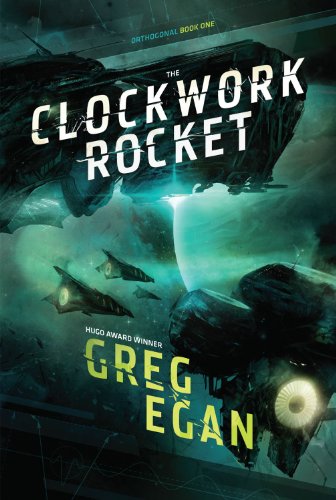
The Clockwork Rocket by Greg Egan has featured prominently in my posts about the books I look forward the most in 2011 (HERE and HERE). The start of the Orthogonal trilogy that takes place into a strange universe where matter is unstable, complex molecules have to be really complex - so the sentient beings that are the heroes of the series like Yalda in this book are six limbed shapeshifters with a strange reproductive biology for example - but people are still people so to speak and they have desires and motivation that we can empathize with...

Well, I just finished the book yesterday afternoon and I *had* to reread it immediately, so powerful it was. I put some very rambling thoughts on Goodreads that need editing at some point in the future and a full review will come here in due course - read those thoughts at your peril since while I do not think they are spoilery, I have to let a little time to pass to really think about this book unemotionally, since besides being a pitch-perfect example of sf and showing why sf is still my favorite genre even after 20+ years of heavy reading in it, the novel is very emotional as literature with characters we care about...

Anyway, while I saw the ending from a long way back it still made me almost cry in a way no sf has done so since the 2005 Honorverse novel At All Costs (FBC Rv) by David Weber whose ending is similarly emotional. Coming back to the Orthogonal trilogy by Greg Egan, the only thing I will add is that I *really, really* want the second installment...

********************************************************


The other novel I talked about in the two above mentioned posts (HERE and HERE) is the The Last Four Things by Paul Hoffman. Somewhat to my surprise, my dual review with Robert Thompson of The Left Hand of God is probably the single most read review of ours here at FBC based on the continual hits it gets daily and of course I am delighted since I *really* loved the book, bought for myself a final edition to complement the review copy I got and I kept inquiring about a review copy for this one for months now.
Link
Due to the quirks of publishing the book will be out in the UK soon, while the print US edition is scheduled for August, but it seems that - in a very wise decision imho - Penguin will sell the ebook in both UK and US (and presumably elsewhere) on April 28 if the Amazon listing HERE is correct.

To my surprise I have received a US edition review copy several days ago and with this the full five books in my original Top 5 Anticipated Post are accounted for - I read the other four and all were superb and will be top novels of 2011.

Needless to say I will get to this one next and will have some thoughts soon, though I have not decided yet when to do the full review. If the Amazon ebook listing holds, I will review it for sure later this month since the book is then officially available here too, otherwise I will see.

Edit 4/16 Some 1/3-1/2 in the book and it is as crazily inventive and good as The Left Hand of God, with the same alternating of styles, tones and narrative modes; there is considerably more backstory and world building and things make sense and hang together well, but the same "all but the kitchen sink" is thrown in and this one has some stuff that's even more outrageously funny than in The Left Hand of God and I found myself shaking with laughter often, though the book is also pretty dark and not for the easily offended.

The Pyramid of Lincoln and (the Bosco ordered forgery to save his and Cale's bacon) The Protocols of the Elders Moderators of Zion Antagonism are among the many early "pearls", and even more than in The Left Hand of God, The Last Four Things abounds with such play on the famous and infamous from history, always well done imho...
And there are battles, treachery, fights, blunders, deep seated plans that may or may not work...

Edit 4/18: About 100 pages to go out of 400+ and The Last Four Things has been all I expected and more; I would have easily finished the book in the weekend but I enjoy it so much that I do not want it to end so every 100-150 pages I reread them before going forward.

Even now and I have no real idea where it will go - I expect a particular ending to this one but who knows, the author keeps throwing surprises as well as underlining how the best laid plans just break because of stupidity, misunderstandings or pure chance. The "all but the kitchen sink" famous and infamous from history continues to delight and the book is just awesome - better than The Left Hand of God in some ways because it hangs things together and makes sense of the "big picture"...

Cale, Bosco, Vague Henry, Kleist and a few more new characters are shining - of course Cale first and foremost - but the rest have also great lines on occasion.

Edit 4/18 later I finished the book and while what I expected to happen, happened, the book went further, twisted again and left me a bit stunned and again without having much of a clue about what's going to happen in the 3rd volume; this time the author has a great two page explanation about his sources, including famous philosophers, Catholic thinkers, poets, obscure manuals of war that are available online and one (in)famous speech of Saddam Hussein (seems to be on YouTube) that *** cribs here before ***.

All in all The Last Four Things takes the promise of the Left Hand of God, fulfills it and more in a considerably more complex book this time with all the world building that was only hinted there, but keeping the narrative switches and the many twists, while the trilogy finale is something I really, really want asap...

Also this is another book like The Clockwork Rocket that will take a while to process, though here I am just somewhat stunned by the ending since the book kept getting darker and darker and went beyond emotion in some ways, more like say The Kindly Ones than the usual sff

********************************************************

LinkNote: So far this year my highly anticipated novels delivered in spades with The Clockwork Rocket and The River of Shadows being #1 in sf and fantasy for now - though to a large extent just because a book has to be number one - and with five more books: Leviathan Wakes, Naamah's Blessing, The Hammer, Embassytown and The Sea Watch on the same level for me - marked as 1-7 in my Goodreads list HERE they are for most part equals for me this year and the order is temporary, though the truly emotional ending of The Clockwork Rocket above and The River of Shadows (see the review) may keep those as #1.

Wednesday, April 13, 2011

Three More Books for 2011: Mann, Anderson, Ballantine/Morris (by Liviu Suciu)

Since for 2011 we have not done an extensive list of anticipated books as in the other years - though we have both the Upcoming Releases Page which tries to be comprehensive and the usual Monthly Spotlights which are closer to what we review here but still somewhat generic - I like to present some of the interesting upcoming releases that I had a chance to look into and even read sometimes, but for which full reviews are still some time off, these being books about which I can comment pertinently.

I also try and update these posts once I finish a book listed here and before I post a full review which supersedes the early and sometimes "rough" impressions, since I think continual feedback is useful and I see way too many posts: "oh, look at this exciting book that is coming soon" only not to be followed up with a review or even early impressions based on actually trying/reading the book.

**************************************************************

First on the list it is the The Immorality Engine from George Mann, the third Newburry/Hobbes adventure, following the Affinity Bridge (FBC Review) and The Osiris Ritual (FBC review). Since the US cover (Tor edition tbp in September) is just awesome and the author confirmed it to be final, I have to post it here in addition to the usual outstanding cover from the UK publishers (Snowbooks edition tbp June).


This was a huge expectation novel that was initially announced for 2010 and I kept pestering the author for a review copy since last fall until I finally got one a week or so ago and I read it basically the next day. I will have a full review in due course but for now a little commentary to whet your appetite and maybe you will try the first two books of this excellent and super fun series that combine the best of Sherlockian deduction, Bond-like adventure, steampunk late Victoriana with a little magic and necromancy too.

"The third Newbury and Hobbes adventure starts dramatically with a funeral of a favorite character and then goes back a week or so to its real start several months after the end of The Osiris Ritual to recount the events that led to said funeral.

The Immorality Engine has the same structure as the first two books - seemingly unrelated mysteries, this time the murder of a high-class jewel thief and an assassination attempt on Queen Victoria - which bring Maurice Newbury out from his opium descent after the events and especially the denouement of The Osiris Ritual which made him question everything about his life, job...

His stout friend Inspector Bainbridge and Newbury's assistant Veronica Hobbes - who intuits that she is at least partly the reason for his descent into full addiction, though unlike us, she does not know exactly why, but things are trickier as we learn during the novel - try desperately to "bring him back" and finally the case of the jewel-thief and later the deeper mysteries involved do so.

The usual combination of great character interaction, inventiveness and several villains that top all such to date plus a lot of moral ambiguities make The Immorality Engine a great culmination of the series to date ending its first arc on a superb note. I am really eager to see where the author takes the series next since the 6 - or even more - books planned seem to be on, though again I want to emphasize that each book tells a complete tale, while these three form a full thematic arc in the larger picture of the series.


**************************************************************


In July, Orbit will publish, The Key to Creation which is the final chapter in the Terra Incognita trilogy of Kevin J. Anderson. The series started strong in The Edge of the World (FBC Review) and continued even stronger in The Map of all Things (FBC review), so this volume is another huge expectation one for me and another one I've been trying to get a review copy for a while now, until finally a copy is on its way.

**********************************(cover may change)

A great cast of characters that you get to care about, superb world building and a lot of twists and turns made this series a favorite, though in true KJA fashion, nobody is safe and any character can die or be utterly changed at any moment. Who is going to survive, who is going to thrive, what will be the final resolution of the seemingly to-the-death conflict between the two people and two religions of the series, what role magic and the disappeared gods will play are some of the questions I expect will be answered here and as mentioned the expectations are really high...

**************************************************************

Finally a debut that I have just found out about and asked for a review copy since I liked the sample chapters, while the blurb is tempting and the cover is just irresistible. This is Phoenix Rising - A Ministry of Peculiar Occurrences Novel - by Pip Ballantine and Tee Morris, a novel that will be published soon by Harper Collins and which I expect to review here in a couple of weeks.

Here is the blurb, while on the authors' website you can find more including a cool trailer HERE.

These are dark days indeed in Victoria’s England. Londoners are vanishing, then reappearing, washing up as corpses on the banks of the Thames, drained of blood and bone. Yet the Ministry of Peculiar Occurrences—the Crown’s clandestine organization whose bailiwick is the strange and unsettling—will not allow its agents to investigate. Fearless and exceedingly lovely Eliza D. Braun, however, with her bulletproof corset and a disturbing fondness for dynamite, refuses to let the matter rest . . . and she’s prepared to drag her timorous new partner, Wellington Books, along with her into the perilous fray.
For a malevolent brotherhood is operating in the deepening London shadows, intent upon the enslavement of all Britons. And Books and Braun—he with his encyclopedic brain and she with her remarkable devices—must get to the twisted roots of a most nefarious plot . . . or see England fall to the Phoenix!